Coming Soon · Math + Music · Ambitious

Guitars & Instruments.

"Using the Rule of 18 to create real instruments."

The most ambitious project in the PBL Math library — and the most rewarding. Students design and build handcrafted, working instruments using the math of music theory. Full curriculum is in development.

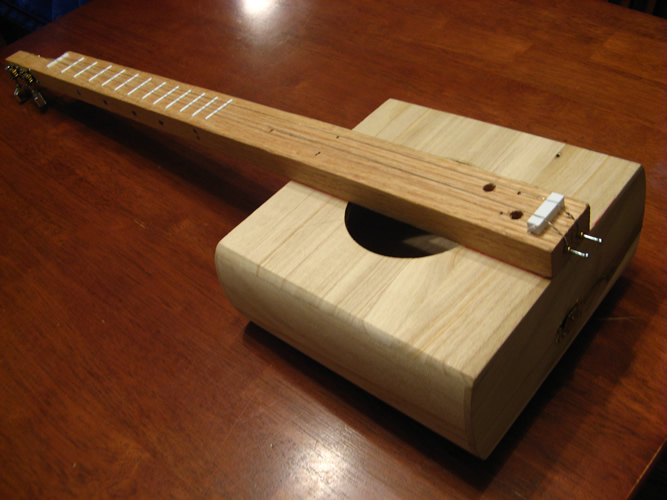
A handcrafted student guitar
Grade Level
7+
Duration
2–5 Months
Cost
$1,500–$4,000
Subjects
Math + Music
Difficulty
Ambitious

This is not a beginner project.

If this is your first PBL unit, do Graf(It) Art or Equation of Me first. But if you're willing to get messy, learn new tools, and bring music into your math classroom, this is hard to keep — students never want to give them back.

Why this works

Where math makes music possible.

Most teenagers walk around with earbuds in. Music is how they build relationships, cope, and have fun. Students are engaged the moment they see that math is what creates the instruments and the songs they love.

Math concepts

Fractions, ratios, geometry.

Music is built on math. The frets, the scale length, the resonance — all derived. This project hits standards across multiple math levels.

  • Fractions: notes, time signatures, fractional inches
  • Decimals: the Rule of 18
  • Symmetry and geometric balance
  • Parallel & perpendicular lines (frets & strings)
  • Volume & surface area (resonance)
  • Ratio: scale drawings, beats per minute
Music concepts

From theory to playing.

Students don't just build the instrument — they learn to play it, write for it, and read the score. The math becomes audible.

  • Frequency and pitch
  • Major and minor chords
  • Basic music theory
  • Read, write, and play music
  • Rhythm and scales
  • The Rule of 18 (fret placement)
PBL outcomes

PBL doesn't get better than this.

Students never ask "when will I use this in life?" In fact, they figure out the math's relevance as you introduce it — because they need it for the project.

  • Real tools, real construction
  • Mistakes become teachable moments
  • Students teach other students
  • Hand-built community in the classroom
  • An instrument they get to keep
Supplies

Tools and consumables.

The big-ticket items (CNC router, miter saw) are one-time investments. If your school has a wood shop or STEAM class, you may already have what you need.

Tools & equipment

One-time investments. Look for school-owned alternatives first.

  • CNC routerCutting soundholes & tuner-peg slots. Laser cutter is an alternative.
  • Screwdrivers
  • ClampsFor gluing parts together.
  • 6" & 12" rulersIncluding 100th-inch precision rulers.
  • Measuring tapeFor scale length of each guitar.

Consumable materials

Per-student or per-class supplies that get used up.

  • Plastruct half-round rods0.1" diameter — for making frets.
  • Plastruct triangular rodsFor making the nut.
  • Plastruct square rodsFor making the bridge.
  • Tuner pegs, guitar strings
  • Wood screws, wood glue, nails
  • Wooden jewelry boxesOr any small wooden boxes as the instrument body.
💡 Apply for grants. DonorsChoose, local arts grants, and STEAM education grants will fund this. The big-ticket tools are one-time purchases — once you have them, future cohorts cost only the consumables.
The curriculum

Three parts. One instrument.

Only Part 1 is fully written. The rest are in active development — get on the list to know when they're ready.

Part 01 ~1 week

The neck.

Before starting
  • Have students keep a journal or notebook documenting their progress throughout the project.
  • Have students create scale drawings (Math 7 standard) of the different parts.
  • Go over safety on day one — and reiterate it every day. I tell students: "Nothing in this classroom is a toy."
For students

Build the neck of your instrument. The neck is what holds the frets, the nut, and connects to the body. Working from your scale drawing:

  • Measure and mark one end for the tuner peg slot.
  • Measure and mark where the tuner pegs will be placed.
  • Measure and mark the other end to create the joint that attaches to the guitar body.
  • Measure and mark the area to glue on the nut.
Teacher notes

The machines used will depend on the instrument blueprint you're working from. My original setup had a band saw, miter saw, and CNC router — all purchased through grants over the years.

First time? Have all students build the same instrument. Seasoned PBL teacher? Let students design and build their own fretted instruments.

Part 02 ~3 weeks In development

The body & frets.

Curriculum being written now.

This is where the Rule of 18 comes in. Students calculate fret positions, place the soundhole, and assemble the body to the neck. The hardest math of the project lives here — and the most rewarding "ah-ha" moments.

  • The Rule of 18 — derived, not just memorized
  • Scale length calculations
  • Soundhole geometry and resonance
  • Body-to-neck joinery
  • String length and tension calculations
Part 03 ~3–6 weeks In development

Tune. Play. Perform.

Curriculum being written now.

Once the instrument is built, students tune it, learn basic theory, write their own short composition, and perform it for the class (or the wider school). The musical math closes the loop.

  • Tuning to standard pitches (frequency)
  • Major & minor chord theory
  • Writing music with fractional notes
  • Performance & recording
  • Final reflection / instrument portfolio
Grading

Rubric coming with the curriculum.

The full rubric is being co-designed with the curriculum — weighted across construction quality, math accuracy, music theory, and performance. In the meantime, the PBL Math Rubric Maker has everything you need to build your own.

Build a rubric you can use right now with whatever portion of this project you decide to run.

Open the Rubric Maker
Stay updated

Want to know when this ships?

Drop me a line and I'll email you when the full Guitars curriculum is published. Got ideas for what should be in it? Even better — tell me what you'd want to see.