Available · Math + English · Day 1 project

Equation of Me.

"A characterization project."

Students introduce themselves as an algebraic identity — a creative bridge between identity, language, and mathematical expression. Three days. Maximum impact. Posted on the wall by the second week of school.

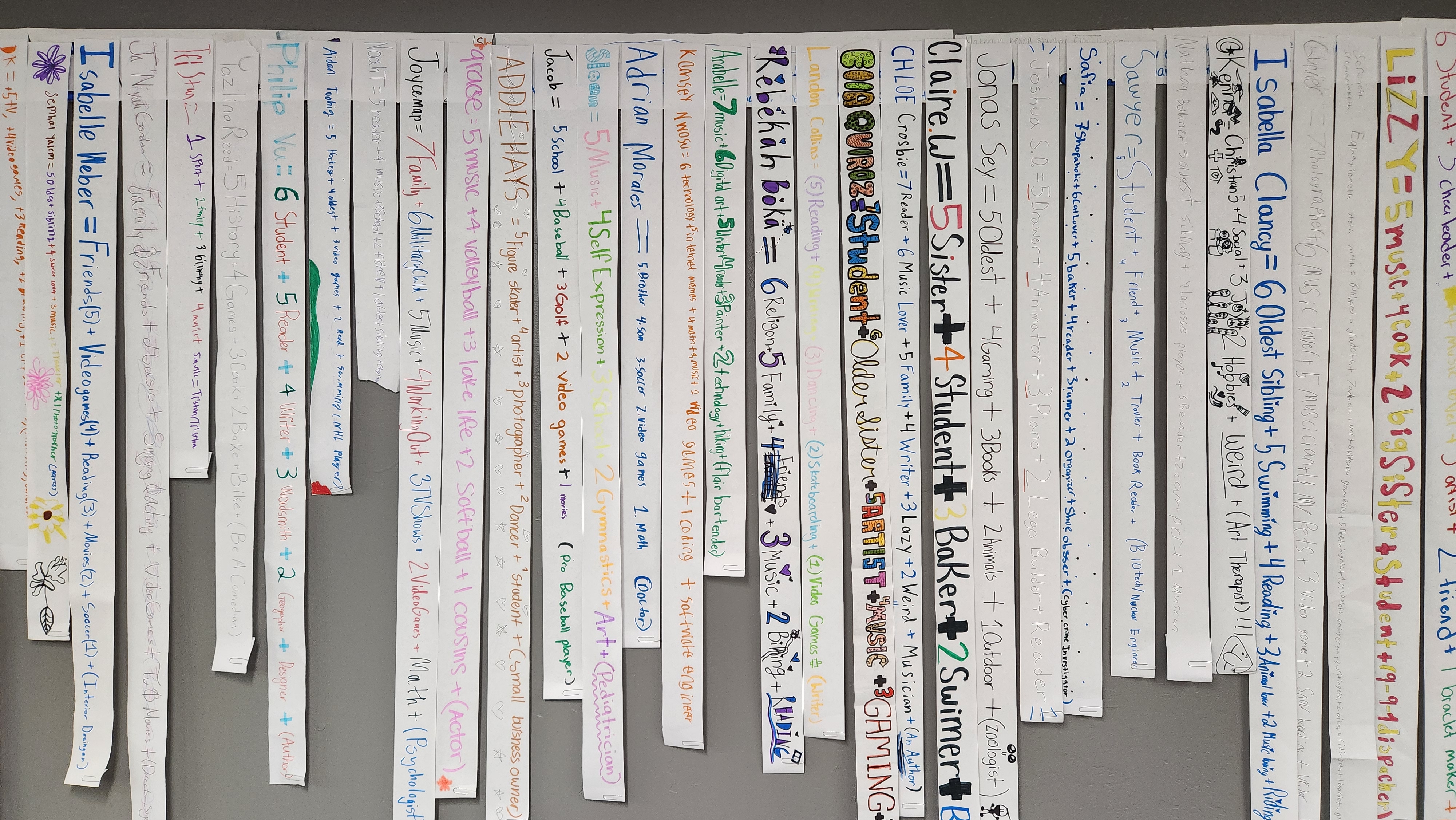
A classroom wall with student equations of me written on long paper ribbons hanging down — each ribbon shows a student's name and weighted descriptors as an algebraic identity.
Student work on the wall
Grade Level
3–12
Duration
~3 days
Cost
~$30
Subjects
Math + English
Best timing
Week 1
Why this works

The fastest way to know your students.

One of the best ways to learn who's actually in your classroom — and to bond students to each other in the first week. Equity starts with knowing what's important to each of them.

Math concepts

Equations as self-portraits.

The most conceptual introduction to equations possible. Coefficients become priorities. Variables become identity. The math is approachable for any grade.

  • Equation vs. expression
  • Coefficients & weighting
  • Variables (words, not just letters)
English concepts

Essay structure that matters.

More English-intensive than math-intensive. Students refresh on essay form — introduction, body, conclusion — but each paragraph is about something they actually care about.

  • Intro / body / conclusion structure
  • Adjectives, verbs, or nouns as variables
  • Drafting & peer critique
PBL outcomes

Set the bar — week one.

The norms you set on this project become the norms for the year. Grade strictly, but let students revise and resubmit. Do it yourself first.

  • First-week culture-setter
  • Builds revision habits
  • Wall display from day one
Supplies

Three items. Big bang for the buck.

Check with your front office first — most schools have cash-register paper rolls sitting in a cabinet from before everyone switched to emailed receipts.

  • 2–3 rolls of 2¼" cash-register POS receipt paper ~$10
  • Thick multi-colored markers (12-pack) ~$8
  • Computers (for typing the essays) Already on hand
💡 Tip: The receipt paper rolls out into long ribbons — perfect for writing the equation in marker, then taping to the wall. Students love seeing their own name in big letters across the classroom.
The curriculum

Three parts. Three days.

The project moves from a self-defining equation to a personal essay to a clean, organized turn-in. Each part has student-facing directions and a teacher's guide.

Part 01 Day 1

The equation.

For students

Express yourself as an identity equation. Use coefficients to stress what's most important to you — and rank them in descending order. Use at least 5 descriptors, then end with a future career choice.

Mr. Huynh's example
Mr. Huynh = 7Teacher + 6Music + 5Hiking + 4Technology + 3Artist + 2Photography + Dance + Career(Curriculum Designer)
For teachers

Descriptors can be nouns, adjectives, or verbs — I'm not picky here because I want students to freely express themselves. If you're collaborating with an ELA teacher, decide together what's most appropriate.

Do the equation yourself first. It's a way to model the project AND to share something about yourself with the class.

Part 02 Day 2

The essay.

For students

Why is each descriptor important to you? Write a body paragraph for each one. There's no length limit — an average paragraph is about 5 sentences. Be thorough so I can understand who you are.

Add an introduction and a conclusion. Look at the example on the course webpage.

For teachers

Do the essay yourself before assigning it. You'll anticipate every question students will have, and you'll have a real model to show — not a generic example.

This is also where you set the norm for drafts. Have students do multiple drafts with peer critiques before turning in. Have them include the drafts with the final project so they can see their own growth.

After the first round, save 2–3 exemplary projects as models for future years.

Part 03 Day 3

The organization.

For students

Before turning in, make sure you've done all of the following:

  • Typed all the parts
  • Included your full name, period, class, and date
  • Included the project guideline handout and rubric as the last page

See the example on the course webpage.

For teachers

This is your first project of the year, so model every part. Show students exactly what excellence looks like. You'll be amazed at the higher quality you get — and you won't have to hand projects back to revise nearly as often.

Grading

Use mine, or build your own.

The rubric is built with the PBL Math Rubric Maker. You can use it as-is, fork it, or build your own.

Sample grading rubric

Weighted criteria covering the equation, the essay, the writing mechanics, and the organization. Print as a blank for student-led reflection, or grade live with auto-totaling.

View the rubric Open Rubric Maker
Student work

What this looks like in real classrooms.

Part of learning is seeing what excellent work looks like. Three student samples and a teacher example are linked below.

Adapt & share

Make it your first-week project.

Download the project requirements, change anything that needs to fit your class, and email me if you've got an idea for how to expand it.